
How does it work?
Here’s the honest answer.
The research is real. The limits are real. We'll tell you both.
Everything is vibration.
That’s not philosophy.
it’s physics.
The chair you're sitting in is vibrating. The light you're reading this by is vibrating. The color you see on this screen is electromagnetic radiation — frequency measured in terahertz. The note A above middle C is air moving at 440 cycles per second. Your heartbeat, your brainwaves, the firing of every nerve in your body — all measurable oscillations.
This is not a metaphor. This is the physical description of reality.
When ancient traditions said "everything is energy" or "the universe is frequency" — they were describing, in the language available to them, something that physics has since confirmed with instruments and equations. The insight was correct. The mechanism just took a few centuries to measure.
Your body is no different. It is a system of oscillating frequencies. When those frequencies fall out of balance — when chronic stress, anxiety, or exhaustion push your nervous system into dysregulation — sound is one of the most direct ways to bring them back.
Not because it's magic. Because it's physics.
Why Your Nervous System Matters.
Chronic stress pushes the nervous system into sympathetic dominance — the fight-or-flight state. When this becomes your baseline, the downstream effects are significant: degraded decision-making, impaired memory, disrupted sleep, elevated cortisol, reduced creative capacity, and physical tension that compounds over time.
You may recognize some of these: the inability to fully switch off. The 3am wake-up. The mental fog that won't clear. The sense that your body is always braced for something.
These are symptoms of a nervous system that hasn't had a chance to return to baseline.
A sound bath creates the conditions for that return. Not by asking you to believe anything. By working directly with the physiological mechanism.
Recalibration. Not Relaxation.
When sound at specific frequencies enters the body, the nervous system responds. The breath slows. Heart rate variability improves. Cortisol levels measurably reduce. The parasympathetic nervous system — the rest and digest state — begins to activate.
This isn't relaxation for its own sake. It's physiological recalibration. The difference matters.
Live performance adds a layer that recordings can't replicate. A practitioner reading the room in real time — adjusting frequency, density, and dynamics based on what's actually happening — creates a responsiveness that no fixed recording can match. The room becomes part of the instrument.
What the electronics do.
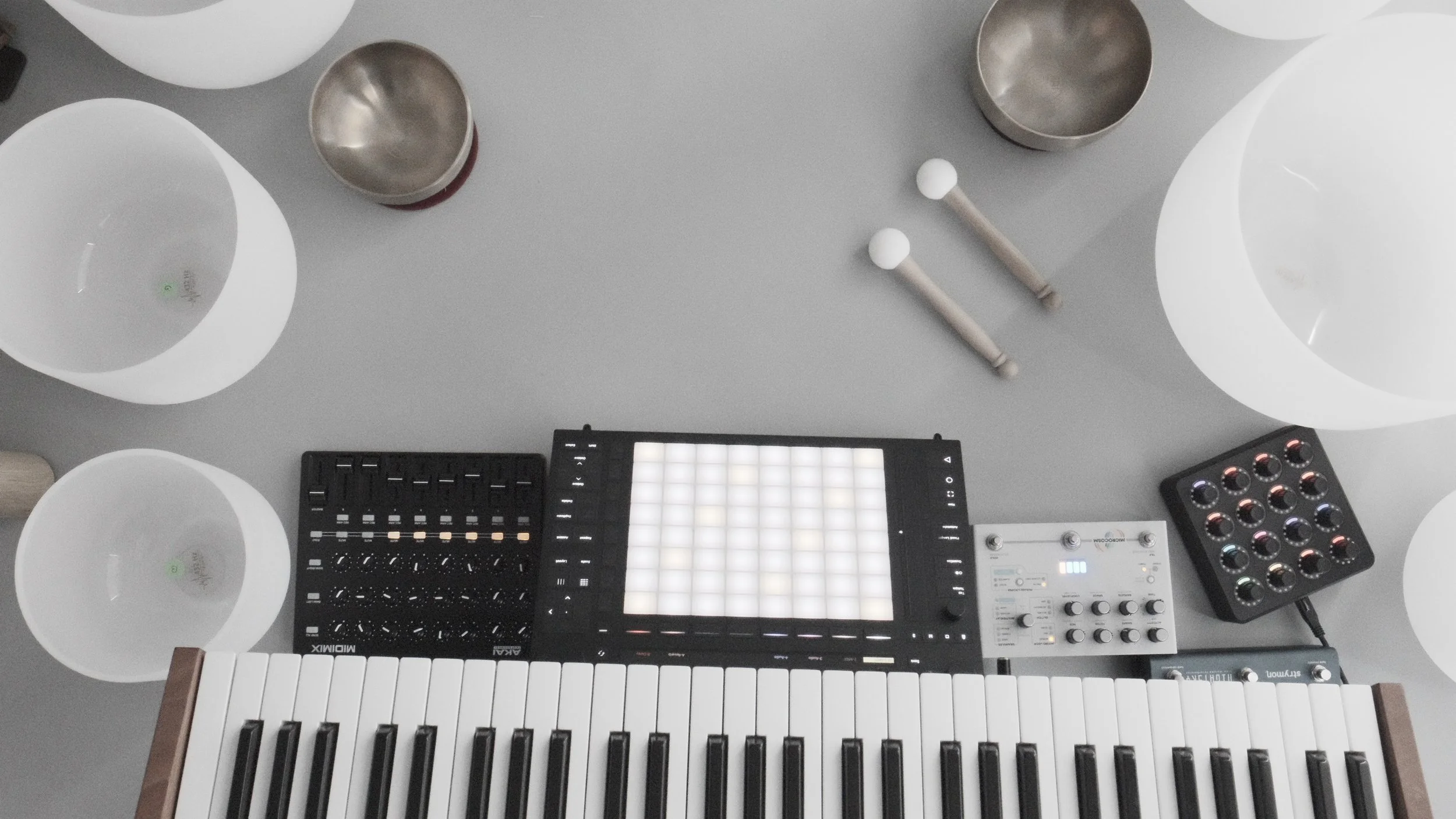
In Ritual Hybrid and Electronic sessions, analog synthesizers and live processing are layered alongside or instead of acoustic instruments. Everything is tuned to 432hz. Everything responds to the room in real time.
This isn't background texture. It's a live instrument — shaped, adjusted, and played the same way the acoustic instruments are. The result is a frequency environment that no acoustic session alone can create.
What are binaural beats?
Binaural beats are a different tool — and an honest one.
They occur when two slightly different frequencies are delivered to each ear through headphones. Your brain perceives a third tone — the difference between them — and entrains to it. Different frequency ranges produce different neurological states: deep sleep, focused attention, stress relief.
Binaural beats don't happen in our live sessions. They require headphones and a controlled frequency environment that live performance can't replicate. That's why they live on our YouTube channel — engineered specifically for that context, where they can do exactly what they're designed to do.
The research on binaural beats is solid. We'll link you to it.
Why 432hz?
The honest answer.
Standard Western tuning places A above middle C at 440hz. 432hz tunes that same note eight cycles per second lower. The difference is subtle — most people can't distinguish it by ear.
The claims around 432hz in wellness circles are significant. Some say it resonates with the natural frequency of the universe. Some say it's more harmonically aligned with nature. Some say it produces measurably different physiological effects than 440hz.
The research doesn't fully support the more expansive claims. Rigorous studies comparing 432hz to 440hz are limited and the results are inconclusive at the level some advocates suggest.
Here's what we do know: lower tuning produces a slightly warmer, more resonant quality in acoustic instruments. It sits differently in the body. Many practitioners — and many listeners — report a qualitative difference in how it feels.
We tune to 432hz because we find it more conducive to the experience we're creating. Not because the science is settled. Because the practice informed the decision.
That's the honest answer.
What the reasearch says.
The honest picture is this: sound bath research specifically is promising but still emerging. Most studies are small. Standardized clinical trials are difficult to design — you can't give someone a placebo gong.
What the adjacent research shows is more established:
Music therapy has demonstrated efficacy in reducing anxiety, pain perception, and depression across hundreds of studies and decades of clinical application.
Vibroacoustic therapy — the use of low frequency sound vibration applied directly to the body — has shown measurable effects on stress, muscle tension, and inflammation.
Auditory beat stimulation, including binaural beats, has been studied for effects on focus, sleep onset, and anxiety reduction with promising results.
Heart rate variability improvement and cortisol reduction following sound-based interventions have been documented in multiple peer-reviewed studies.
The mechanism is real. The research is catching up to the practice. We'll link you to the studies that have earned citation.
Will I Feel It immediately?
Most people notice something in the first session. A shift in how they feel. A depth of relaxation they haven't accessed in a while. Something they can't quite name.
Some people feel nothing the first time — and everything the second. Some need three sessions before the effect becomes clear. Some arrive so depleted that the first session is mostly their nervous system remembering what rest feels like.
None of these are wrong responses. They're all data.
What the research suggests — and what experience confirms — is that the effects compound. A single session is a beginning. A regular practice is where the real recalibration happens.
We don't promise transformation. We create the conditions. What you do with them is yours.
The Claims
What we don’t claim.
Sound baths cure anything
They replace therapy, medication, or medical treatment
Every person feels the same thing
One session solves chronic problems
What we DO claim.
Intentional sound at specific frequencies measurably affects the nervous system
Cortisol reduces
Parasympathetic activity increases
Recovery from cognitive load improves
That's the claim. Everything else is yours to interpret.
The variable a recording can’t replace.
A recording delivers fixed frequencies at fixed intensities in a fixed sequence. It cannot respond to what's happening in the room. It cannot adjust when the energy shifts. It plays the same way for every person in every space every time.
A live session introduces a variable that recordings can't replicate — a practitioner reading the room in real time. Adjusting frequency, density, and dynamics based on what's actually happening. This responsiveness is not just an artistic choice. It's a functional one.
The nervous system doesn't exist in isolation. It responds to its environment — including the presence of another human being making intentional decisions in real time. That variable matters. Research on the therapeutic relationship in clinical settings consistently shows that human presence and attunement amplify outcomes.
An app cannot attune. A playlist cannot read the room. A live practitioner can.
This is why we play live. Every time.
Go Deeper.
The science doesn't end here. Two places to continue:
For the researchers.
Field Notes is where we go long — specific mechanisms, honest conversation about what sound does and what it doesn't. Start with the research post.
For the Curious.
Still have questions? The FAQ covers the most common ones — practical, honest, no fluff.